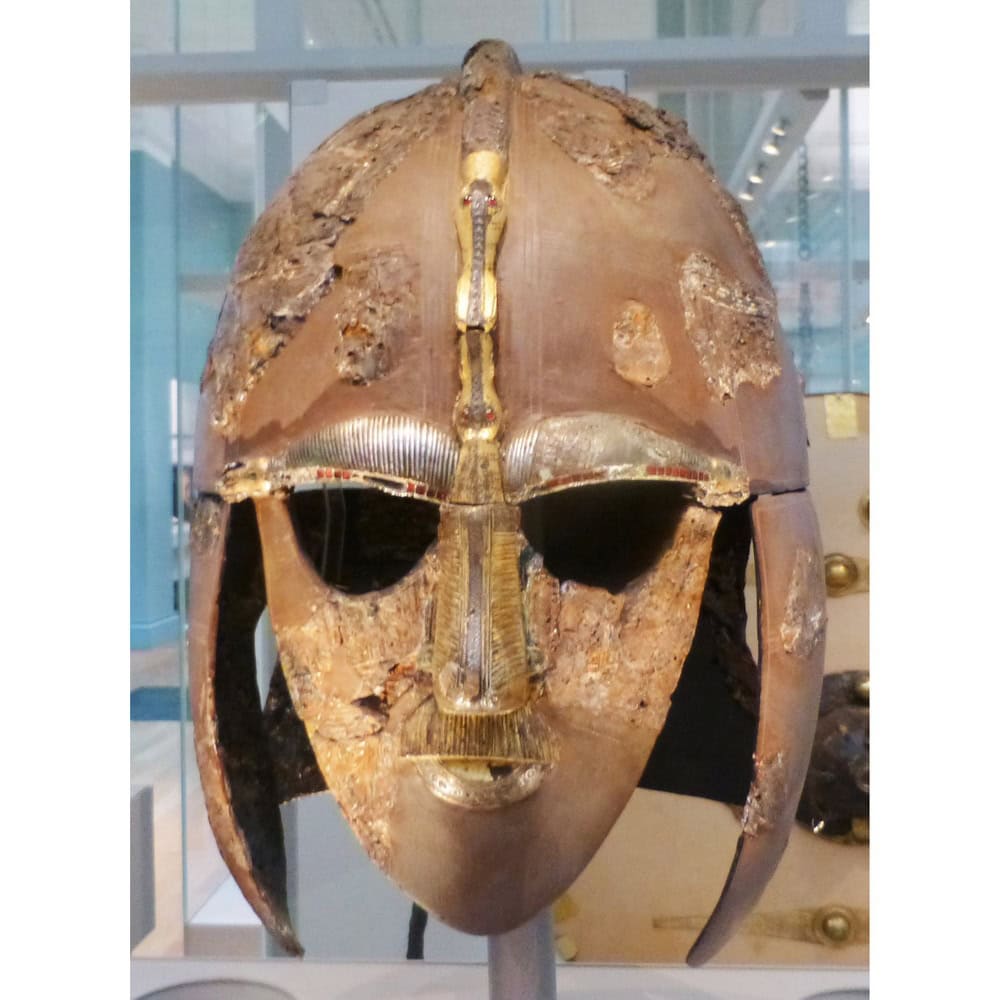
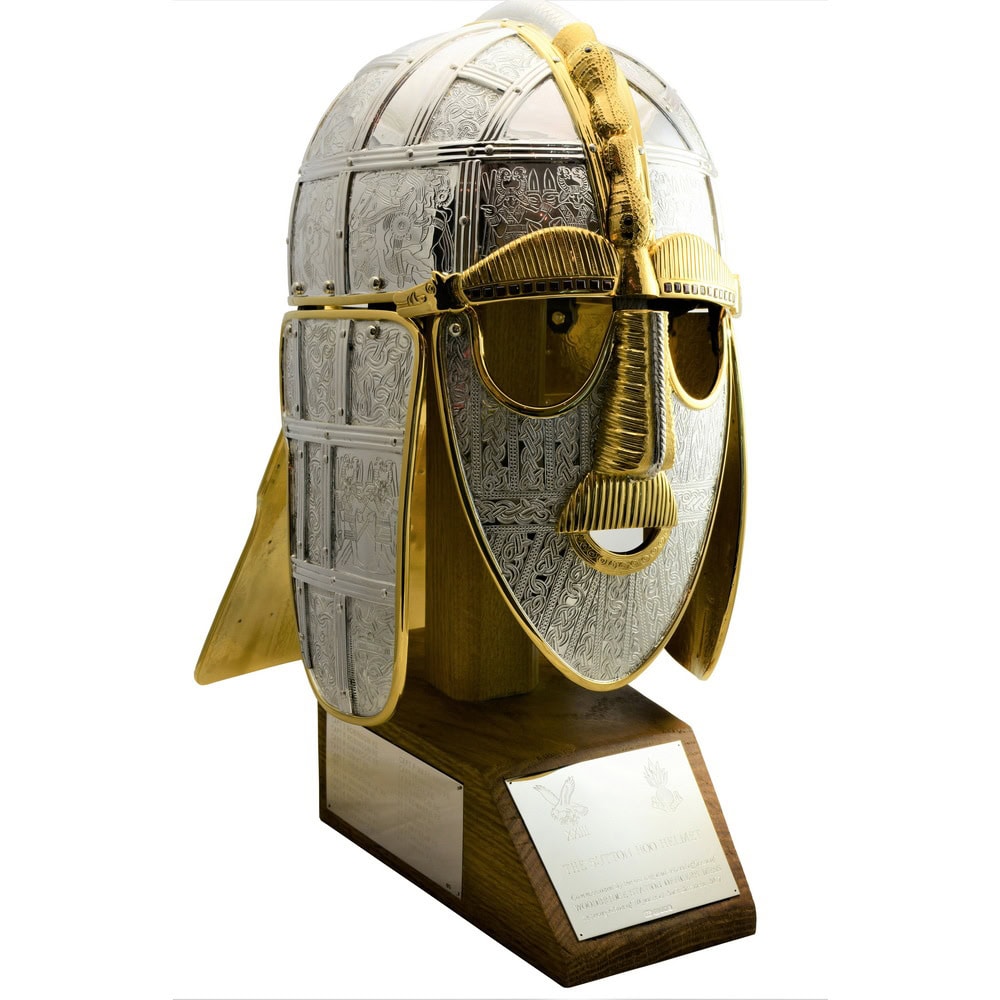
An Anglo-Saxon helmet was found in 1939 when the Sutton Hoo ship-burial was being excavated. The elaborately decorated helmet dates from 620-625 CE and is widely associated with the Anglo-Saxon leader, King Raedwald of East Anglia.
We were commissioned by a regiment stationed near Sutton Hoo to create a copy in silver.
The first restoration can be seen in the British Museum, London. Original elements from the excavation were positioned onto a contemporary helmet former.
Side view Sutton Hoo helmet
The accredited version
Displayed next to the original is this version of the helmet, which was thoroughly researched and accredited with being a very possible version of what the helmet might have looked.
Forming the helmet
A circular sheet of silver was ‘spun’ up into a bowl shape, which was then hammered into a head shaped ovoid.
Pitch filling
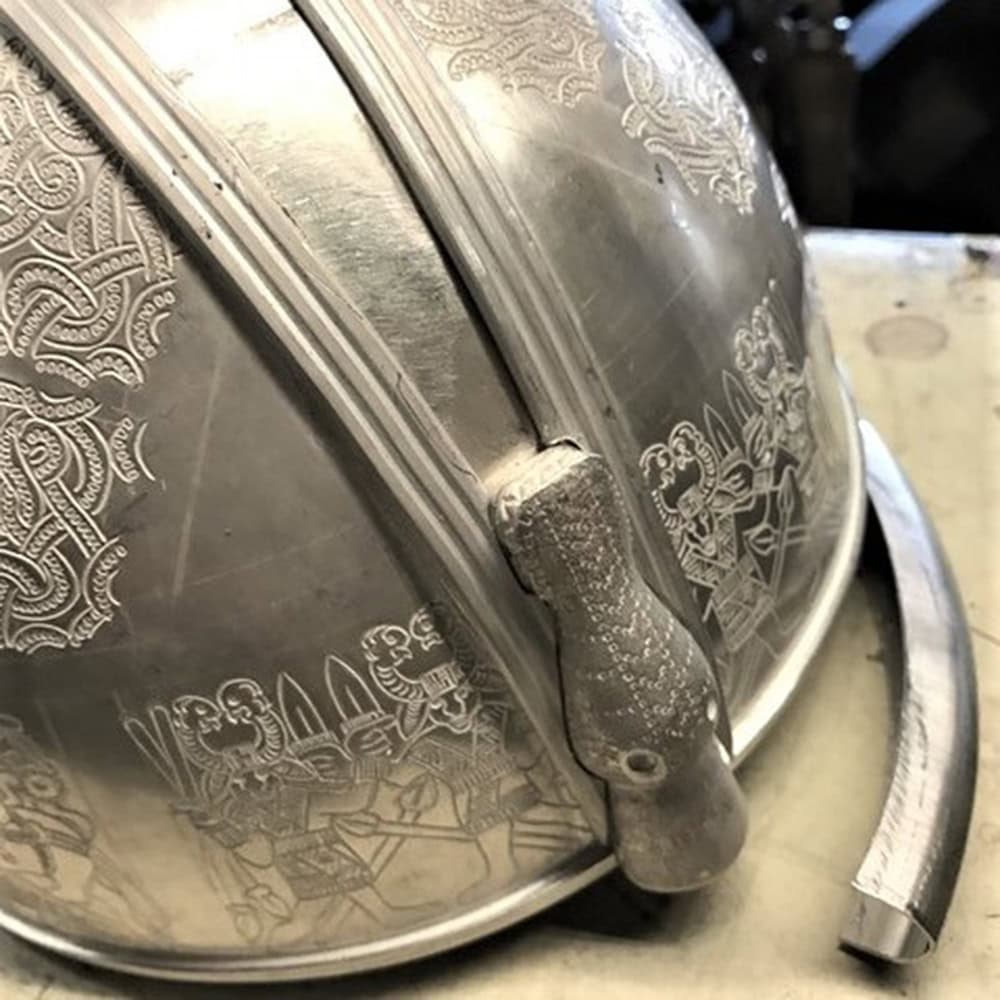
The chaser uses punches to create the design; the bowl is filled with pitch which allows him to work while the overall shape is maintained.
Marking out the design
Each ‘panel’ within the ovoid followed a design theme but each was different in detail.
Chasing
The chaser uses a punch and hammer to ‘chase’ the design into the surface of the silver, known as linear chasing.
Chasing nearing completion
This represents many many hours of painstaking highly skilled work.
Wires and decorative embellishments
We carved the decorative elements in wax and then cast them into silver with specially prepared wires shaped to fit neatly over the helmet.
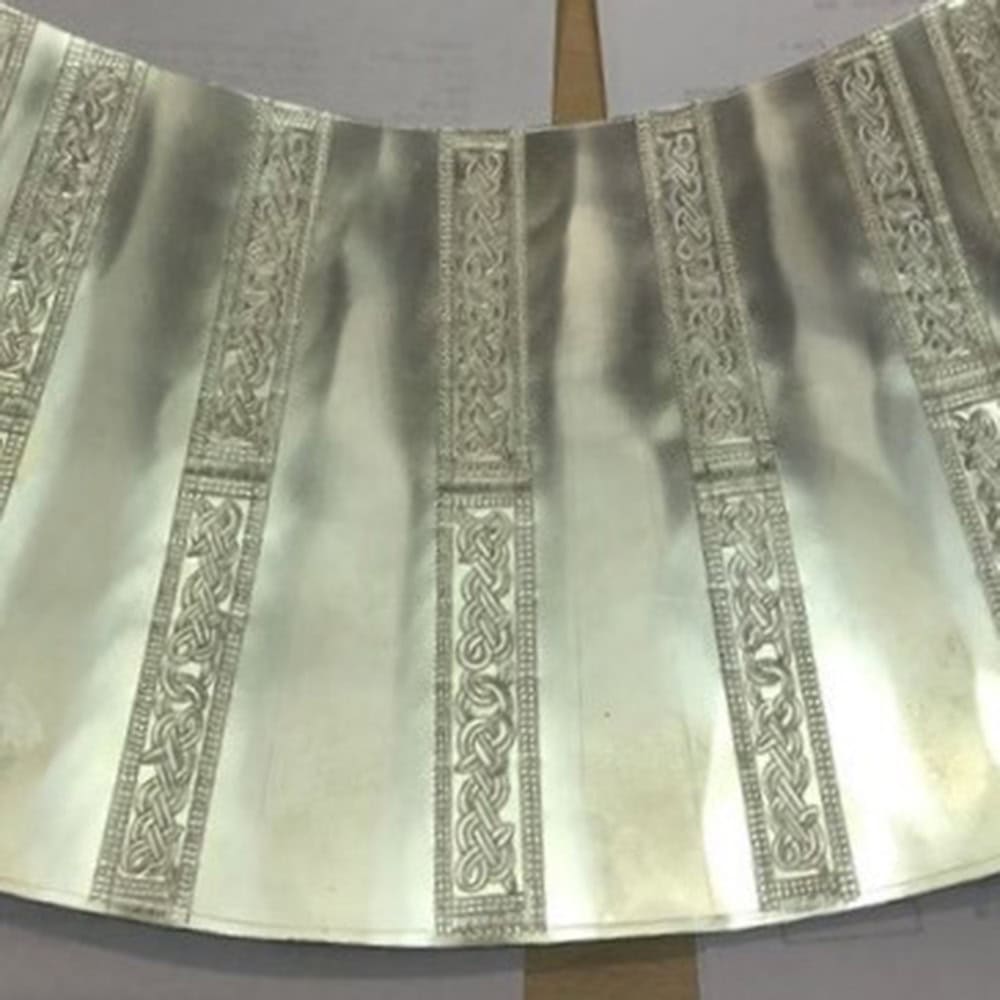
Making the neck guard
The sheet of silver has been cut into a fan shape embellished with the chased decoration.
Shaping the neck guard
The flat sheet hammered up into shape with edge wires soldered on.
Side panels
The chased side panels with wires soldered on ready for the final polishing.
Decorative wires
Hand-made ridged wires being positioned, cut to fit and soldered between every chased panel.
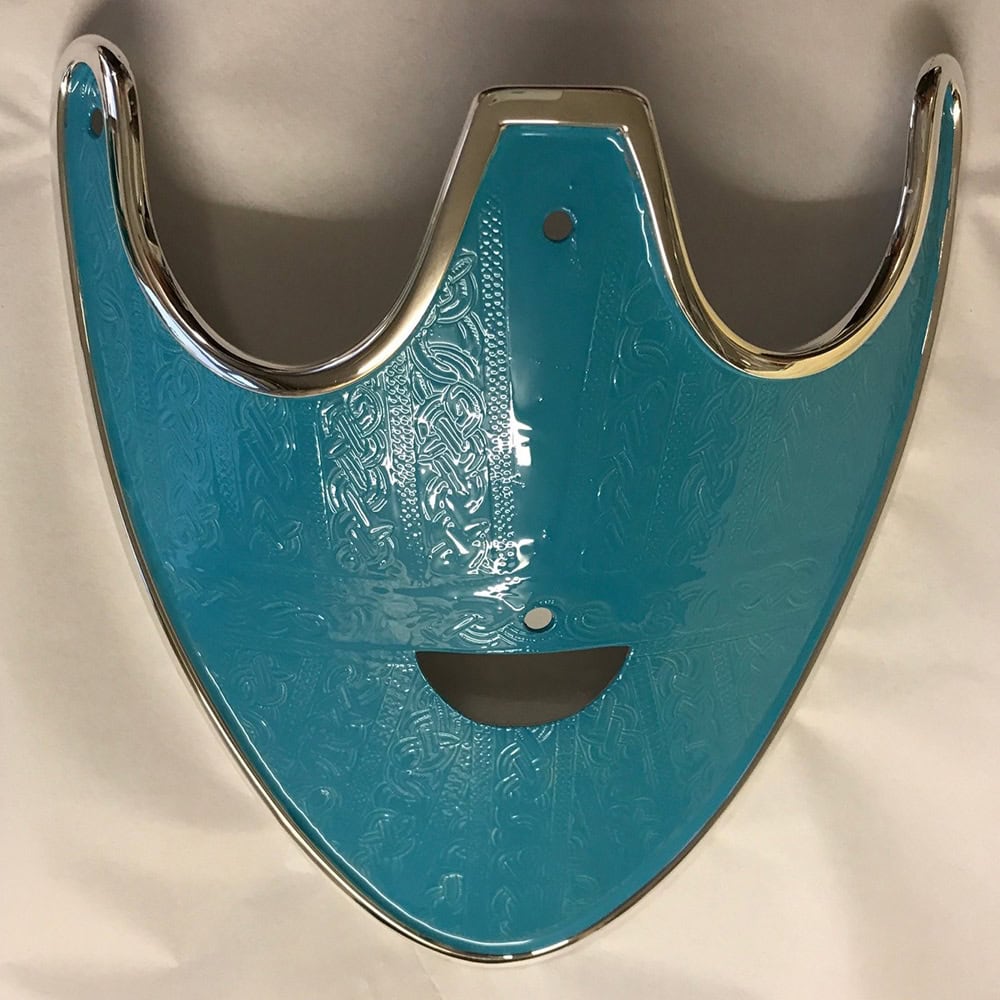
The face mask
Different elements being temporarily put together to ensure a perfect fit.
The silversmith & chaser’s work completed
The polisher must take great care not to over polish the details while still bringing the silver surface to a gleaming finish.
Preparation for gilding
A process called ‘stopping out’ in which those parts not to be gilded are covered.
Polished helmet
With all the wires soldered on and the central ridge in place everything is prepared for the rivetting.
Face plate elements
The gilded nose and mouth ready to be rivetted, onto the face plate.
Mouth detail
The gilded mouth with silver chased surface around.
Hallmarking
Every item of silver is submitted to an independent Assay Office to test the purity of the silver. Here we see the detail of the hallmark.
Eyebrow detail
Each eyebrow is gilded and set with square cut garnets.
Sutton Hoo warrior helmet
This was a wonderful commission which took some 18 months to complete bringing together every single silversmithing skill and technique.